
Nominal vs Actual Lumber Dimensions Chart: Wood Sizing Guide
Comprehensive nominal vs actual lumber size chart for 1x, 2x, 4x, and 6x boards. Learn why wood shrinks during planing and how it affects board feet calculation.
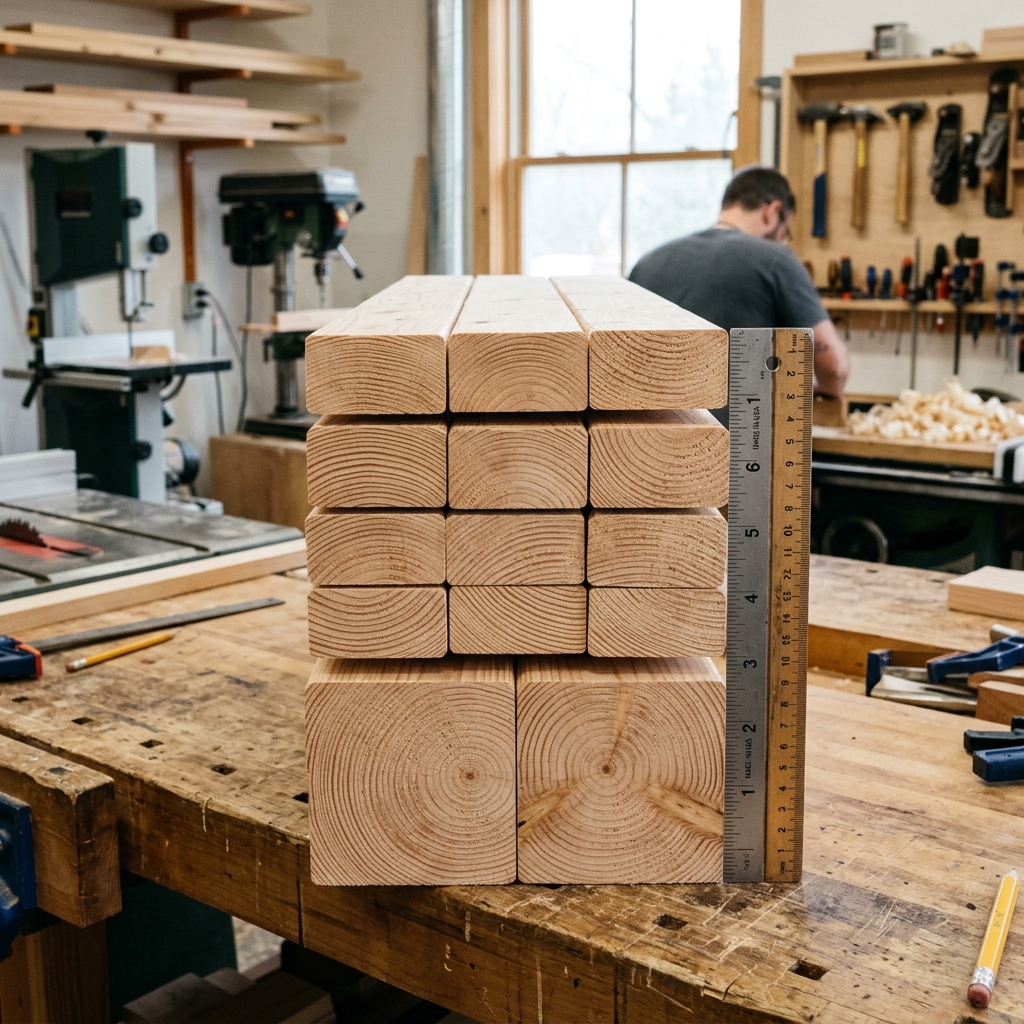
Featured Image: Nominal vs Actual Lumber Dimensions Chart: Wood Sizing Guide
If you have ever picked up a 2×4 board at a lumber yard and measured it, you probably noticed it isn’t actually 2 inches by 4 inches. Instead, it measures 1.5 inches by 3.5 inches.
Why is there a difference between nominal and actual dimensions? How does this discrepancy affect your material estimates on a BDFT calculator?
This guide provides a comprehensive Nominal vs. Actual Lumber Size Chart and explains how to account for finished lumber sizes in your woodworking calculations.
Why Is Lumber Smaller Than Its Name?
Lumber sizes are split into two categories:
- Nominal Size: The size of the green, rough-sawn lumber board before it is dried and planed smooth.
- Actual Dressed Size: The final dimension of S4S (Surfaced 4 Sides) lumber after kiln-drying and surfacing.
During the milling process, rough lumber shrinks as moisture evaporates. The sawmill then surfaces (planes) all four faces smooth, reducing thickness and width by 1/4 inch to 1/2 inch.
Complete Nominal vs Actual Lumber Size Chart
1-Inch Softwood & Hardwood Board Sizes (S4S)
| Nominal Size | Actual Thickness | Actual Width |
|---|---|---|
| 1 × 2 | 0.75” (3/4 in) | 1.5” (1 1/2 in) |
| 1 × 3 | 0.75” (3/4 in) | 2.5” (2 1/2 in) |
| 1 × 4 | 0.75” (3/4 in) | 3.5” (3 1/2 in) |
| 1 × 6 | 0.75” (3/4 in) | 5.5” (5 1/2 in) |
| 1 × 8 | 0.75” (3/4 in) | 7.25” (7 1/4 in) |
| 1 × 10 | 0.75” (3/4 in) | 9.25” (9 1/4 in) |
| 1 × 12 | 0.75” (3/4 in) | 11.25” (11 1/4 in) |
2-Inch Framing & Dimensional Lumber Sizes
| Nominal Size | Actual Thickness | Actual Width |
|---|---|---|
| 2 × 4 | 1.5” (1 1/2 in) | 3.5” (3 1/2 in) |
| 2 × 6 | 1.5” (1 1/2 in) | 5.5” (5 1/2 in) |
| 2 × 8 | 1.5” (1 1/2 in) | 7.25” (7 1/4 in) |
| 2 × 10 | 1.5” (1 1/2 in) | 9.25” (9 1/4 in) |
| 2 × 12 | 1.5” (1 1/2 in) | 11.25” (11 1/4 in) |
Precision Sizing & Digital Conversion Utilities
Accurate dimensional measurements are crucial not just in carpentry, but across all technical fields. For example, graphics designers working with timber blueprints use a JPEG to SVG converter to turn raw images into scalable vectors. Similarly, structural engineers use an engineering converter to analyze pressure loads, or rely on a matrix calculator for complex load-bearing math.
Just as engineers rely on precision tools, digital businesses use AI automation to eliminate operational friction and scale productivity.
Heavy Timbers & Posts (4x & 6x)
| Nominal Size | Actual Thickness | Actual Width |
|---|---|---|
| 4 × 4 | 3.5” (3 1/2 in) | 3.5” (3 1/2 in) |
| 4 × 6 | 3.5” (3 1/2 in) | 5.5” (5 1/2 in) |
| 6 × 6 | 5.5” (5 1/2 in) | 5.5” (5 1/2 in) |
How Nominal vs Actual Sizing Impacts Board Feet Calculations
Hardwood lumber is usually sold by rough nominal quartering system:
- 4/4 (Four-Quarter) = 1” rough thickness (Surfaces to 13/16” or 3/4”)
- 5/4 (Five-Quarter) = 1.25” rough thickness (Surfaces to 1-1/16”)
- 6/4 (Six-Quarter) = 1.5” rough thickness (Surfaces to 1-5/16”)
- 8/4 (Eight-Quarter) = 2.0” rough thickness (Surfaces to 1-3/4”)
When buying rough hardwood, board footage is computed based on rough nominal thickness. However, for construction lumber, volume estimation uses actual finished sizes.
Check your exact dimensions using our free Wood Weight Calculator and Lumber Calculator.
Frequently Asked Questions (FAQ)
What is the actual width of a 2x8 board?
The actual width of a nominal 2x8 board is 7.25 inches (7 1/4 inches), with an actual thickness of 1.5 inches.
Why is 4/4 hardwood called four-quarters?
Hardwood sawmills measure rough thickness in quarter-inch increments. 4/4 stands for $4/4 = 1.0 \text{ inch}$ rough thickness before planing.
Related Resources
- Lumber Calculator – Estimate board feet for dimensional lumber and framing timber.
- JPEG to SVG Converter – Convert raster images into high-resolution vector graphics.
- Determinant Solver – Fast matrix determinant calculator and linear algebra tool.
- PSI Converter – Convert gauge pressure to absolute pressure for engineering projects.
- Shahab Dev – AI software solutions, web applications, and custom software development.