
Log Scaling Rules Explained: Doyle vs Scribner vs International 1/4
Master log volume scaling formulas: Doyle Log Rule, Scribner Dec C, and International 1/4-Inch Rule. Learn how sawmills estimate board foot yields from timber logs.
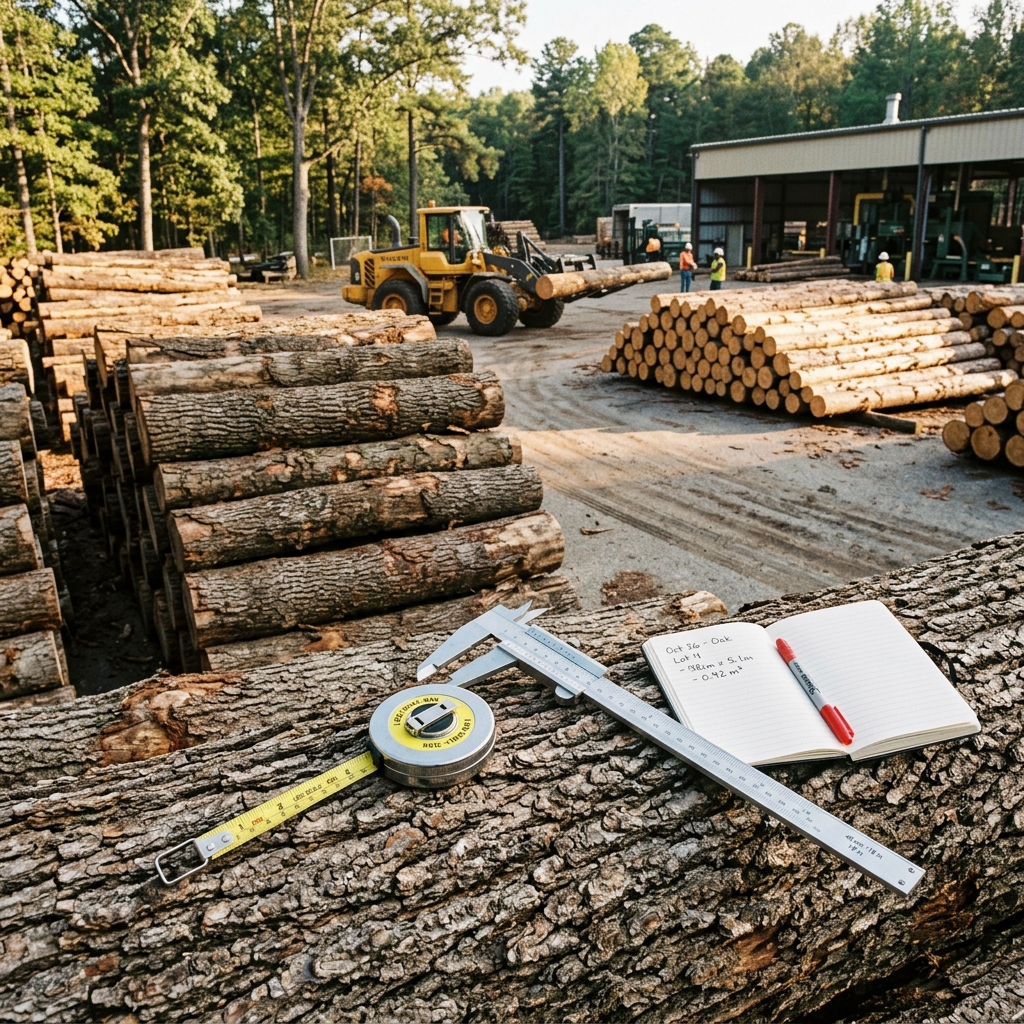
Featured Image: Log Scaling Rules Explained: Doyle vs Scribner vs International 1/4
When buying standing timber or selling harvested tree logs to a sawmill, board foot yield is estimated using log scale rules. Unlike square lumber boards measured with a standard construction calculator, logs are cylindrical and tapered, requiring specialized scaling formulas.
The three dominant log scale rules used in North America are:
- Doyle Log Rule
- Scribner Decimal C Rule
- International 1/4-Inch Rule
This guide breaks down the mathematics behind each formula and explains which rule yields the most accurate board foot estimation.
1. Doyle Log Rule
The Doyle Log Rule is the oldest and most widely used log scale rule in the central and eastern United States.
Doyle Formula
$$\text{Board Feet} = \left(\frac{D - 4}{4}\right)^2 \times L$$
Where:
- $D$ = Diameter inside bark at the small end of the log (inches)
- $L$ = Log length (feet)
Key Characteristic of Doyle
- Underscales small logs (under 28 inches in diameter) because it overestimates slab and kerf losses by deducting a fixed 4 inches for slab waste.
- Overscales very large logs (over 36 inches in diameter).
Sawmill Mathematics & Engineering Solvers
Calculating timber volume involves geometry and spatial algebra similar to advanced mathematical modeling. Engineers evaluating structural forces use a determinant calculator for linear algebra calculations, or rely on a coordinate converter for vector transformations.
Sawmills looking to increase digital lead generation and local search rankings utilize a comprehensive website audit tool or consult a skilled hire a developer expert to build custom sawmill software.
2. Scribner Decimal C Log Rule
Developed by J.M. Scribner in 1846, the Scribner Log Rule uses diagrammatic drawings of log cross-sections to determine the maximum number of 1-inch boards that can be sawn from a log, assuming a 1/4-inch saw kerf.
Key Characteristic of Scribner
- Rounded to the nearest 10 board feet (Decimal C).
- Does not account for log taper along its length, slightly underestimating yields on long logs (16+ feet).
3. International 1/4-Inch Log Rule
Developed by Judson F. Clark in 1906, the International 1/4-Inch Rule is considered the most mathematically accurate log rule for modern commercial sawmills.
Formula Basis
It calculates volume in 4-foot log sections, incorporating:
- 1/4-inch saw kerf allowance
- 1/16-inch shrinkage factor
- Standard log taper of 1/2 inch per 4 feet of log length
$$\text{Board Feet} = 0.22 D^2 - 0.71 D \quad \text{(per 4 ft section)}$$
Log Rule Comparison Table (16-Foot Log)
Below is a comparison of estimated board footage for a 16-foot log across different small-end diameters:
| Small-End Diameter ($D$) | Doyle Scale (BF) | Scribner Scale (BF) | International 1/4” Scale (BF) |
|---|---|---|---|
| 12 inches | 64 BF | 80 BF | 95 BF |
| 16 inches | 144 BF | 160 BF | 180 BF |
| 20 inches | 256 BF | 280 BF | 290 BF |
| 24 inches | 400 BF | 400 BF | 425 BF |
| 28 inches | 576 BF | 580 BF | 585 BF |
Notice how Doyle significantly underestimates timber yield on smaller diameter logs (12” to 16”).
Frequently Asked Questions (FAQ)
Which log scale rule gives the highest board foot yield?
The International 1/4-Inch Rule provides the highest and most accurate board foot yield estimation for small to mid-sized sawlogs.
How do I calculate log board feet automatically?
Use our dedicated Log Scaling Calculator to instantly compare Doyle, Scribner, and International rules.
Related Resources
- Logs Calculator – Estimate board foot volume using Doyle, Scribner, and International 1/4” rules.
- Determinant Solver – Linear algebra and matrix determinant math solver.
- Rectangular to Polar Coordinates – Convert rectangular cartesian coordinates to polar form.
- Instant SEO Scan – Run an automated technical SEO audit and track keyword performance.
- Shahab Dev Portfolio – Custom software development, web engineering, and enterprise AI solutions.